gdd
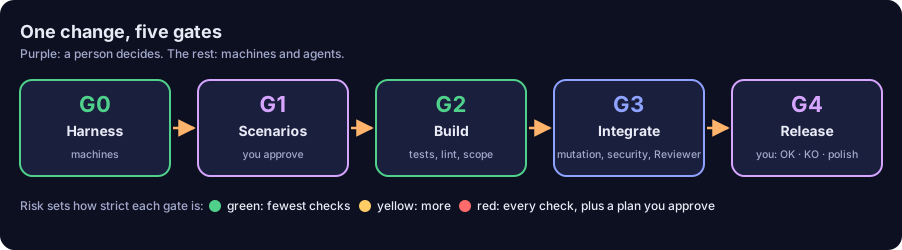
Build software with AI coding agents, one gate at a time. Risk decides how many gates a change meets; machines check what can be checked; you decide only what needs a person, in as few sittings as possible.
-
Learn
From an empty folder to a released change in about half an hour, then the method in one page.
-
Do
Run changes, write scenarios, answer the Release Gate, adopt an existing project, fix what breaks.
-
Look up
Every command, configuration key, gate, role, stack and file. Exact and complete.
-
Understand
Why gates, how risk is judged, what keeps agents safe, why you stop so rarely.
Learn
Step by step, from nothing to a released change.
- Your first change: set up a project, write and approve a scenario, launch the change and answer its Release Gate.
- GDD in one page: the phases, the gates and the traffic light, with a diagram of each.
Do
Guides for a goal you already have.
Day to day
- Install gdd: the binary, the agents and the tools the gates use.
- Run a change: create it, launch it and follow it on the Board.
- Write and approve scenarios: Gherkin, hidden examples and the Scenario Gate (G1).
- Answer the Release Gate: OK, KO or polish at G4.
- Get a parked change going again: the Decision Inbox, relaunches and merge conflicts.
Shaping the work
- Map and approve red zones: tell gdd which paths are risky.
- Explore with a spike: a fixed budget, variants side by side, an ADR.
- Run changes in parallel: the cap, overlaps and the merge queue.
Setting up and tuning
- Bring gdd to an existing project: init, bootstrap and adopt.
- Choose agents and models: who builds, who reviews, per color.
- Tune the gates: the commands each gate runs, limits and mutation testing.
- Release versions and keep a changelog: tags,
gdd release, CHANGELOG.md. - Run the gates in CI: what the workflow checks on every pull request.
- Measure the work: tokens, flow time, DORA and Learn.
- Upgrade gdd in a project: new versions of the files gdd wrote.
- Troubleshooting: symptoms, causes and fixes.
Look up
Exact and complete. The command reference is generated from the code.
- Command reference: every command of
gddand its options. - Configuration: every file in
gdd/and every key. - Gates: what each gate checks, who decides and its limits, by color.
- Roles: the human, the Orchestrator, the Builder and the Reviewer.
- Stacks: the Python, Rust and TypeScript sheets.
- Files gdd writes: records, the log, the Decision Inbox and outputs.
- Environment variables: what gdd reads and what it gives agents.
- Glossary: the words these pages use.
Understand
Why GDD works the way it does.
- GDD in one page: phases, gates, colors and roles.
- The life of a change: every step of a launch, in order.
- How risk picks the gates: the traffic light and why color wins.
- Keeping agents honest: Path Guard, hidden examples and what the agents cannot touch.
- Few stops for the human: sittings, polish and why done is not good.
- Measuring what matters: tokens, DORA and the kill rule.
- Design decisions: what was chosen, and what was not.
This project, built with GDD
gdd is built with GDD, so its own GDD files are real examples of every artifact:
- The method's full rules and the roadmap.
- Project Brief, standards, decisions and Discover notes.
- Scenarios: the executable specification of gdd.
Contribute
- Contributing: set up, test and send a change.
- Writing the docs: how these pages are organised and written.
- Changelog.